

Introduction
Adding grades and inclines to your model railroad layout brings it to life, creating realistic mountain passes, hillside towns, and dramatic elevation changes. Whether you’re modeling a mountain railroad or simply want to add visual interest, building a smooth, reliable incline is a fundamental skill every model railroader should master.
Understanding Grade Percentages
A grade is expressed as a percentage — the number of inches of rise per 100 inches of horizontal run. For example, a 2% grade rises 2 inches over 100 inches of track. Here’s a quick reference:
- 1% grade – Very gentle; suitable for long trains and heavy consists
- 2% grade – The recommended maximum for most model railroads
- 3% grade – Steep; expect reduced train length and pulling power
- 4%+ grade – Very steep; best reserved for short, light trains or trolleys
As a rule of thumb, keep grades at 2% or less for reliable, trouble-free operation.
Planning Your Incline
Before cutting any foam or wood, plan your incline on paper or in track planning software. Key considerations include:
- Total rise: How high does the track need to climb?
- Available run: How much horizontal distance do you have?
- Transition curves: Allow at least 18–24 inches of level track at the top and bottom of the grade to prevent cars from uncoupling or derailing.
Use the formula: Grade % = (Rise ÷ Run) × 100 to verify your planned grade before building.
Materials You’ll Need
- Extruded foam insulation board (1″ or 2″ thick) or plywood subroadbed
- Commercial incline sets (e.g., Woodland Scenics Incline Starter Set) or homemade risers
- Carpenter’s glue or foam-compatible adhesive
- Sandpaper (medium grit)
- Ruler, pencil, and a long straightedge
- Track and roadbed
Method 1: Commercial Incline Sets
The easiest approach for beginners is a pre-made incline system like the Woodland Scenics Incline Starter Set. These foam risers are pre-cut to a consistent 2% grade and stack to achieve your desired height.
- Dry-fit the risers along your planned route to confirm the grade and fit.
- Glue the risers to your layout base using foam-compatible adhesive.
- Allow to dry fully before laying roadbed and track.
- Sand any transitions smooth to prevent bumps that could cause derailments.
Method 2: Homemade Foam Risers
If you prefer a DIY approach, you can cut your own risers from extruded foam board.
- Calculate the height needed at each support point based on your grade percentage and spacing.
- Cut foam blocks to the appropriate heights, incrementing gradually along the run.
- Glue the blocks in place and lay a strip of 1/8″ or 1/4″ foam or thin plywood over the top as a smooth subroadbed surface.
- Sand transitions at the top and bottom of the grade for a smooth entry and exit.
Method 3: Plywood Cookie-Cutter or L-Girder Construction
For benchwork-based layouts, inclines are often built by tapering the subroadbed itself:
- Mark the rise and run on your subroadbed strip.
- Use a jigsaw to cut a gentle taper along the length of the subroadbed.
- Support the elevated end with risers or adjustable legs attached to the benchwork.
- Ensure the subroadbed is firmly supported at regular intervals to prevent flex.
Laying Track on the Incline
Once your subroadbed is in place, laying track on a grade is similar to level track — with a few extra precautions:
- Use flexible track for smooth, kink-free curves on grades.
- Spike or glue track securely — gravity can cause track to shift over time.
- Test with your longest, heaviest locomotive before scenicking to catch any problem spots.
- Avoid placing turnouts (switches) on grades whenever possible.
Testing Your Grade
Before adding scenery, run trains repeatedly over the incline to verify reliable operation:
- Test with the longest train you plan to run.
- Check for derailments at the transition points at the top and bottom of the grade.
- Verify that your locomotive can pull the intended load without stalling.
- If trains struggle, consider reducing the grade or shortening train length.
Adding Scenery to Your Incline
Once operation is confirmed, the incline becomes a natural focal point for scenery. Consider:
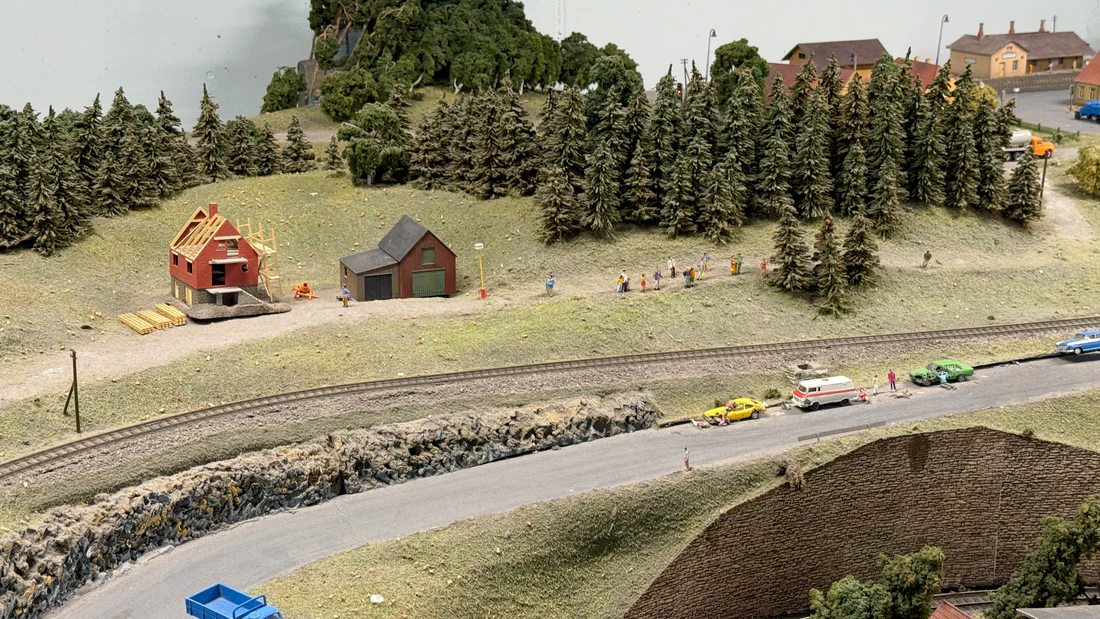
- Rocky cuts and retaining walls along the sides of the grade
- Tunnels through hills at the top of the incline
- Bridges and trestles spanning valleys below
- Ground cover, trees, and rock castings to blend the grade into the landscape
Final Tips
- Always build and test your incline before adding scenery — it’s much easier to fix problems early.
- Keep grades consistent — avoid sudden changes in grade percentage mid-run.
- Label your grade percentage on your track plan for future reference.
- When in doubt, go shallower — a 1.5% grade is always more reliable than a 3% grade.
- Do not add a turnout (switch to a branch line) at the beginning or at the end of an incline.
With careful planning and construction, a well-built incline will add drama and realism to your layout for years to come. Happy modeling!