Introduction
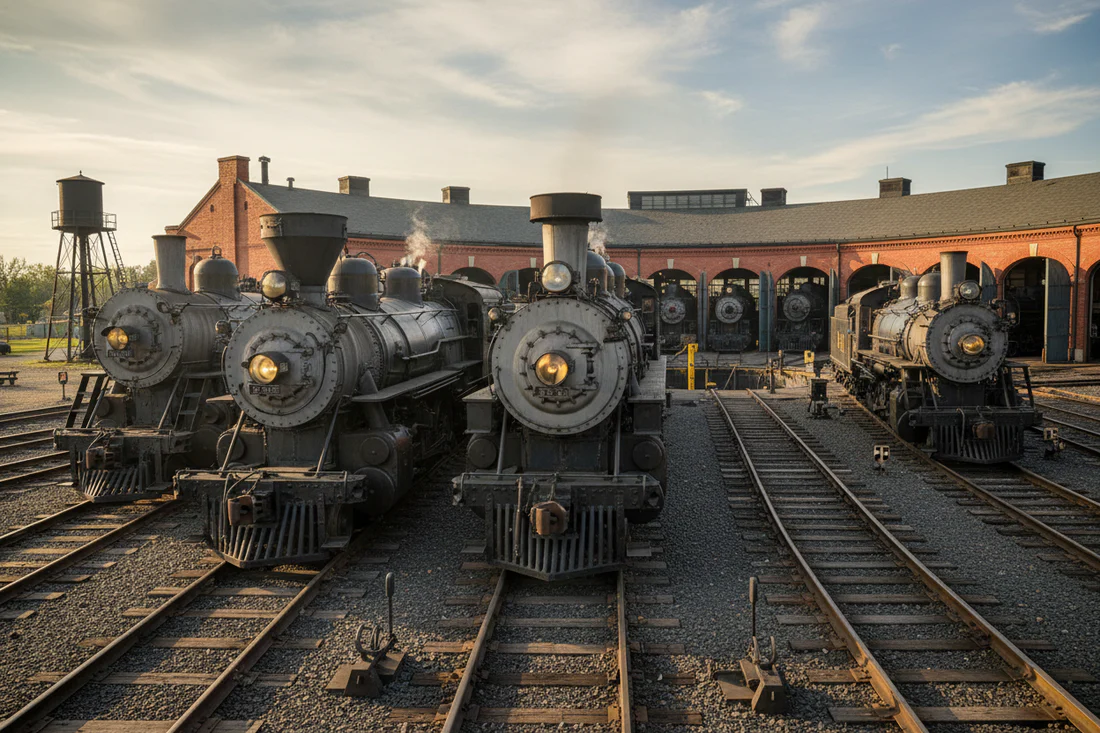
The 1940s and 1950s represent the final golden age of steam in North America. As diesel locomotives began their relentless march across the continent, steam engines reached their peak of power and sophistication before fading from mainline service. For model railroaders and railroad historians alike, being able to identify the iconic steam locomotives of this era is both a rewarding skill and a gateway to understanding the railroads that shaped a nation.
This guide covers the most recognizable steam locomotive types of the 1940s–1950s, how to identify them, and which railroads ran them.
Understanding Whyte Notation
Steam locomotives are classified using the Whyte notation system, which counts the number of leading wheels, driving wheels, and trailing wheels. For example, a 4-8-4 has 4 leading wheels, 8 driving wheels, and 4 trailing wheels. This system makes it easy to categorize and compare locomotive types at a glance.
The Big Players: Common Steam Types of the Era
4-8-4 “Northern” (or “Niagara,” “Greenbrier,” “Pocono”)
The 4-8-4 was arguably the most versatile and widely used steam locomotive type of the late steam era. Designed for high-speed passenger and fast freight service, these engines were powerful, smooth-riding, and capable of sustained high speeds.
- How to recognize it: Four-wheel lead truck, eight large driving wheels, four-wheel trailing truck. Long, streamlined boiler with a large firebox supported by the trailing truck. Many were shrouded in streamlined shrouding.
- Notable examples: New York Central “Niagara” (S1b class), Union Pacific FEF series, Norfolk & Western “J” class, Southern Pacific “GS” (Golden State) series
- Typical service: Premier passenger trains and fast freight
2-8-2 “Mikado”
The Mikado was the workhorse freight locomotive ofthe early-to-mid 20th century. By the 1940s, many were being displaced by larger power but remained common on secondary lines and branch freight service.
- How to recognize it: Two-wheel lead truck, eight driving wheels, two-wheel trailing truck. Compact, utilitarian appearance with a smaller firebox than later designs. Often seen without streamlining.
- Notable examples: Found on virtually every major railroad; USRA Light and Heavy Mikado designs were nearly universal.
- Typical service: General freight, branch lines, secondary mainlines
2-8-4 “Berkshire”
An evolution of the Mikado, the Berkshire added a four-wheel trailing truck to support a much larger firebox, dramatically increasing steaming capacity and power. It became the dominant fast freight locomotive of the 1940s on many eastern railroads.
- How to recognize it: Two-wheel lead truck, eight driving wheels, four-wheel trailing truck. Noticeably larger firebox and boiler than a Mikado. Often equipped with Boxpok or disc drivers.
- Notable examples: Chesapeake & Ohio “Kanawha,” New York Central “Mohawk,” Erie Railroad, Nickel Plate Road (NKP) — the NKP Berkshires are among the most celebrated.
- Typical service: Fast freight, merchandise service
4-6-4 “Hudson”
The Hudson was the premier passenger locomotive of the 1930s and 1940s, named after the New York Central’s famous line along the Hudson River. Sleek, fast, and powerful, Hudsons were often the face of a railroad’s passenger service.
- How to recognize it: Four-wheel lead truck, six driving wheels, four-wheel trailing truck. Elegant proportions with a long boiler. Many were streamlined with shrouding designed by industrial designers like Henry Dreyfuss.
- Notable examples: New York Central J-1 through J-3 classes (the J-3a “Dreyfuss Hudson” is iconic), Chicago, Burlington & Quincy, Milwaukee Road
- Typical service: Named passenger trains, high-speed service
4-6-2 “Pacific”
The Pacific was the standard passenger locomotive of the early 20th century and remained in widespread use through the 1940s, particularly on secondary passenger runs as larger power took over premier assignments.
- How to recognize it: Four-wheel lead truck, six driving wheels, two-wheel trailing truck. Smaller and lighter than a Hudson, with a more compact firebox. A classic, balanced silhouette.
- Notable examples: Found on nearly every railroad; Pennsylvania Railroad K4s is perhaps the most famous Pacific in North America.
- Typical service: Passenger trains, secondary mainline service
2-10-4 “Texas” (or “Colorado,” “Selkirk”)
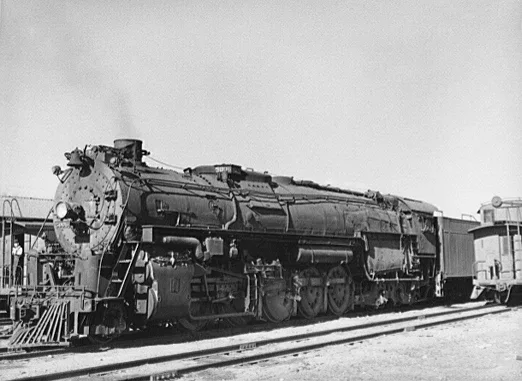
The 2-10-4 was a heavy freight locomotive designed for moving large tonnage over challenging grades. It extended the Mikado concept with ten driving wheels and a large four-wheel trailing truck.
- How to recognize it: Two-wheel lead truck, ten driving wheels, four-wheel trailing truck. Very long locomotive with a massive boiler and firebox. The ten drivers give it a distinctive, powerful stance.
- Notable examples: Chesapeake & Ohio “Texas” type, Pennsylvania Railroad J1, Canadian Pacific “Selkirk”
- Typical service: Heavy freight, coal and ore trains
4-8-2 “Mountain”
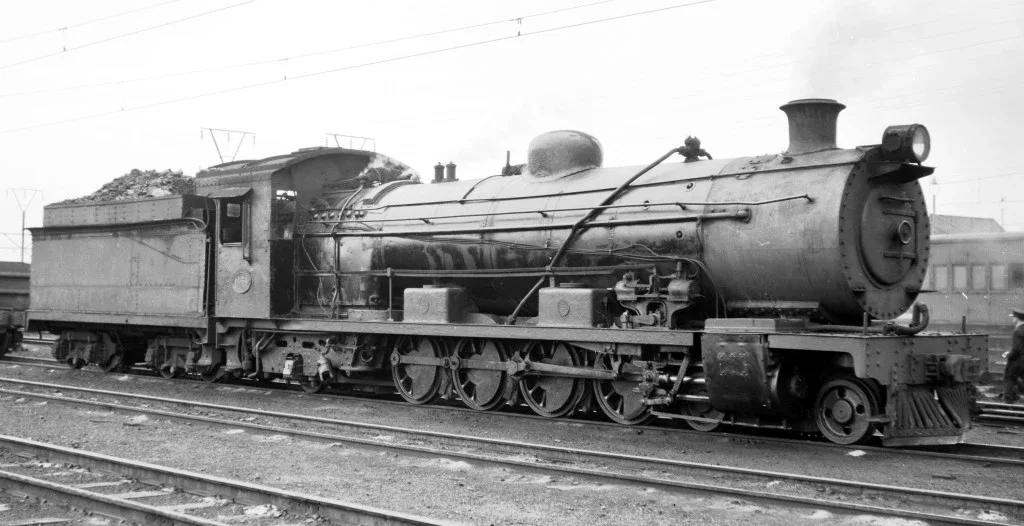
The Mountain type was a dual-service locomotive used for both passenger and freight work, particularly over hilly or mountainous terrain. It bridged the gap between the Pacific and the larger 4-8-4.
- How to recognize it: Four-wheel lead truck, eight driving wheels, two-wheel trailing truck. Larger than a Pacific but with a smaller trailing truck than a Northern. Often found in mixed service.
- Notable examples: New York Central “Mohawk” (before the Berkshire took over freight), Southern Railway, Louisville & Nashville
- Typical service: Passenger and freight over mountain grades
2-6-6-2 and 2-8-8-2 Articulated (Mallet) Types
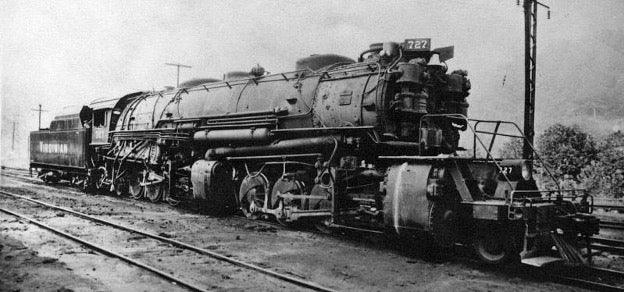
Articulated locomotives used two sets of driving wheels under a single boiler, allowing enormous power in a locomotive that could still navigate curves. They were common on mountain railroads and heavy coal haulers.
- How to recognize it: Two separate engine units under one boiler — look for two sets of cylinders and two sets of drivers. Very long and low-slung compared to conventional locomotives. Often heard before they were seen, with a distinctive exhaust beat.
- Notable examples: Norfolk & Western Y6 class (2-8-8-2), Chesapeake & Ohio H-8 “Allegheny” (2-6-6-6), Baltimore & Ohio EM-1 (2-8-8-4)
- Typical service: Heavy coal and mineral trains, mountain grades
Key Visual Identification Tips
When spotting steam locomotives in photographs or on the layout, look for these clues:
- Count the drivers: The number and size of driving wheels is the fastest way to narrow down the type.
- Check the lead and trailing trucks: A two-wheel lead truck suggests a freight locomotive; a four-wheel lead truck usually means passenger or dual-service power.
- Look at the firebox: A large, wide firebox extending behind the last driver indicates a large trailing truck and high steaming capacity — a sign of late-era, high-power designs.
- Streamlining: Shrouded locomotives were almost always passenger power. Look for skirting, shrouded headlights, and smooth boiler jackets.
- Tender size: Large, high-capacity tenders with water scoops (for picking up water on the fly) indicate mainline passenger or fast freight service.
- Road markings: Railroad lettering and paint schemes are often the easiest identifier — each railroad had distinctive colors and lettering styles.
Modeling These Locomotives
All of the locomotive types covered in this guide have been produced in HO, N, O, and S scales by manufacturers including Athearn, Broadway Limited Imports, Bachmann, MTH, and Walthers. When selecting a model, look for:
- Correct Whyte classification for your chosen railroad and era
- Accurate road-specific details (cab style, tender type, driver size)
- DCC and sound-ready or factory-installed decoders for realistic operation
Conclusion
The steam locomotives of the 1940s and 1950s represent the pinnacle of steam technology — powerful, refined, and deeply tied to the character of the railroads that operated them. Whether you’re building a layout set in this era or simply want to appreciate the photographs and films of the time, knowing how to recognize these iconic machines adds a whole new dimension to the hobby. Happy railroading!